
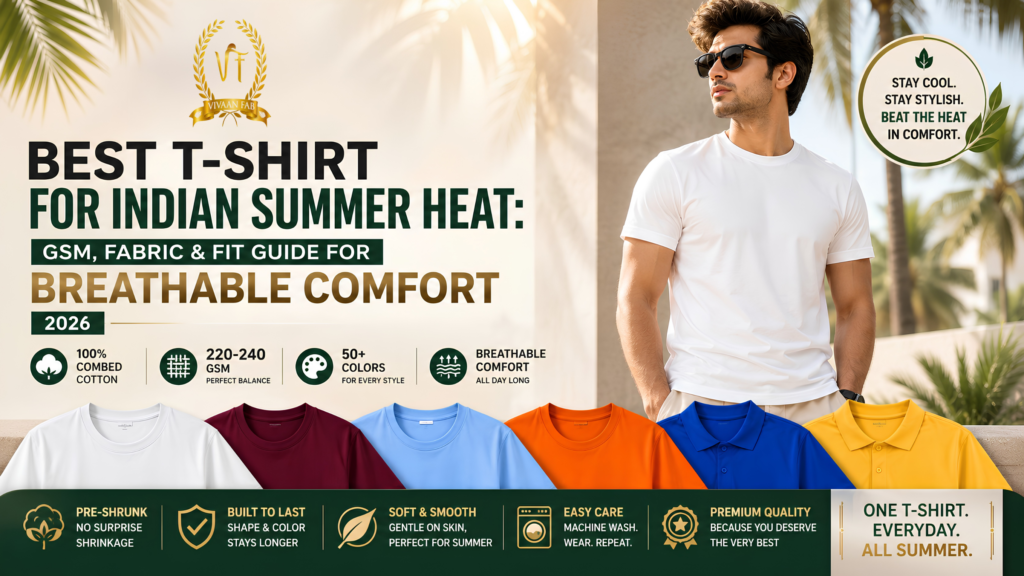
Best T-Shirt for Indian Summer Heat: GSM, Fabric & Fit Guide for Breathable Comfort 2026
Indian summers are unforgiving. Temperatures soar past 40°C, humidity sits thick in the air, and the “feels like” temperature often makes you feel like you’re walking inside an oven. But here’s what most people don’t realize: the right t-shirt can make the difference between dreading summer and actually enjoying it.
The problem isn’t that summer is hot. The problem is that most people buy the wrong t-shirt—too thick, too tight, wrong fabric, wrong color. They suffer through the season wearing clothes that trap heat instead of allowing their body to regulate naturally.
This guide breaks down exactly what makes a t-shirt actually work in Indian heat. Not just theoretically, but practically. We’ll cover fabric science, GSM (the number nobody reads but everyone should), color strategy, fit principles, and how to identify brands that actually deliver breathability without sacrificing durability.
By the end, you’ll know more about summer t-shirts than 99% of shoppers. And you’ll never buy the wrong one again.
Why Most T-Shirts Fail in Indian Summer
Before we talk about what works, let’s understand why most t-shirts fail.
The Heat Trap Problem
Your body cools itself through sweat evaporation. When you sweat, moisture rises to your skin’s surface. If your clothing blocks this process—if the fabric is too dense, too tight, or made from synthetic materials—that sweat just sits there. The moisture doesn’t evaporate. Instead, it builds up, creating a hot, damp microclimate against your skin. This is why you feel uncomfortably hot even when you’re not moving.
Heavy fabrics (think 240+ GSM in cheap cotton) act like insulation. They trap heat instead of releasing it. They also tend to hold onto sweat, making clothes feel damp and sticky.
The Transparency Trap
The opposite problem is buying t-shirts that are too thin. Below 160 GSM, cotton becomes almost translucent. In bright sunlight, you can see right through it. The fabric feels flimsy. After a few washes, it stretches out, loses shape, and develops that “I’ve worn this for five years” sagging look in month one.
Thin fabrics also don’t absorb sweat effectively. When you sweat, the moisture sits on the surface instead of being absorbed into the fabric, which means wet, clingy clothes that stick to your skin.
The Synthetic Fakery
Polyester and synthetic blends are promoted as “moisture-wicking” and “quick-drying.” This is true for gym clothes and performance wear. But for everyday summer wear, synthetics are a trap. They don’t breathe like cotton. They trap heat in humid conditions. They hold odors. And they create that awful feeling when humidity is high—that plastic-wrapped sensation that makes you feel even hotter.
The Fit Disaster
Tight-fitting t-shirts are classic mistakes in summer. Skinny fits, tapered bodies, tight sleeves—they all restrict airflow. Your body generates heat. If your clothes don’t allow air to circulate around that heat, it builds up.
Oversized fits work better, but only if they’re intentional oversized (with proper proportions) not just “I bought the wrong size” oversized (which looks sloppy and shapeless).
The Science Behind Summer T-Shirts: GSM, Fiber Quality & Weave
If you want to choose the right summer t-shirt, you need to understand three technical factors: GSM, fiber quality, and weave type. These determine how a shirt actually behaves in heat.
GSM: The Weight That Matters
GSM stands for Grams Per Square Meter. It literally measures how much one square meter of fabric weighs.
For summer t-shirts, GSM tells you whether the fabric will breathe or trap heat.
160–180 GSM: Lightweight Summer Wear
At this weight, the fabric is thin but not transparent (if it’s good quality). The weave is open enough that air passes through easily. You get maximum breathability.
This is perfect for:
- Peak summer heat (April–June in India)
- Outdoor activities in direct sunlight
- Days when you’ll be moving around and generating body heat
- People who run hot naturally
Trade-off: Below 180 GSM, fabrics become see-through if the quality is poor. They also don’t hold sweat as effectively, so moisture sits on the surface instead of being absorbed.
180–200 GSM: The Sweet Spot
This range hits the balance that most Indian summers demand. The fabric is substantial enough to hold its shape and absorb sweat. But it’s light enough to breathe and allow air circulation.
This is perfect for:
- All-purpose summer wear (office, casual outings, weekend)
- Layering (you can wear it alone or under a shirt)
- Extended outdoor time without feeling like you’re wearing insulation
- Durability—it can handle 50+ washes without degrading
Why this range works: Vivaan Fab positions itself at 220–240 GSM combed cotton. While heavier than typical summer wear, the high-quality combed cotton means it breathes better than cheaper 180 GSM fabrics. The weave is engineered to allow airflow despite the weight.
200–240 GSM: Structured Summer Wear
At this weight, you’re buying fabric that prioritizes structure and durability over maximum breathability. The fabric holds its shape. Prints sit perfectly. The tee looks intentional and polished even after multiple washes.
This is perfect for:
- Evening wear (when temperatures drop slightly)
- Streetwear and fashion-forward styling
- Graphic tees where print quality matters
- People who want longevity (these tees last 3+ years)
Trade-off: In peak afternoon heat (April heat in Delhi), 220+ GSM feels heavier. If you’re outdoors for hours in direct sun, lightweight is objectively more comfortable.
The Key Insight: GSM alone doesn’t determine quality. A 240 GSM tee made from poor-quality, low-twist cotton will feel rough and trap heat. A 180 GSM tee made from premium combed cotton will breathe better and feel softer. It’s the combination of GSM + fiber quality that matters.
Fiber Quality: Combed vs. Ring-Spun vs. Open-End Cotton
Not all cotton is equal. The way fibers are processed before they’re spun into yarn determines how soft, durable, and breathable your t-shirt will be.
Combed Cotton (The Standard for Quality)
Combed cotton has fibers that are literally combed before spinning. This removes short fibers, knots, and impurities. The result: smoother surface, softer hand-feel, less pilling, longer lifespan.
Combed cotton is the gold standard for quality t-shirts in the ₹400–₹800 price range. Vivaan Fab uses combed A1 grade cotton—which means it’s the top tier of combed cotton.
Ring-Spun Cotton (The Premium Tier)
In ring-spun processing, fibers are twisted tighter during spinning. This creates an even finer, more compact yarn. Ring-spun cotton is:
- 2-3x softer than regular combed cotton
- More resistant to pilling
- Stronger and more durable
- Usually 20-30% more expensive
Ring-spun cotton is used by premium brands like XYXX and certain Supima cotton collections. You feel the difference immediately when you touch it.
Open-End / OE Cotton (The Budget Option)
This is spun faster using a different process. It’s cheaper to produce but results in a rougher fabric with shorter lifespan. Most t-shirts under ₹300 use OE cotton.
For Indian Summers: Combed cotton is the right choice. It offers the best balance of breathability, softness, and durability. Ring-spun is luxurious but unnecessary for everyday summer wear.
Weave Type: Single Jersey vs. Double Knit
How the fibers are knitted together affects breathability and structure.
Single Jersey (Most Common)
Single jersey is one layer of knitted fabric. It’s lightweight, breathable, and flexible. Good single jersey at 180 GSM breathes better than heavy double knit.
Most summer t-shirts use single jersey because it maximizes airflow.
Double Knit / French Terry
Double knit is thicker, warmer, and more structured. It’s used for hoodies and sweatshirts, not summer wear. It traps heat and is wrong for India’s climate.
For Summer: Single jersey is the only logical choice. It’s the reason lightweight t-shirts actually breathe.
The Indian Summer Equation: Heat + Humidity = Different Rules
India’s summer isn’t just hot. It’s hot AND humid. This creates a unique set of challenges that most international summer clothing guides don’t account for.
Coastal Cities (Mumbai, Goa, Kochi): High Humidity
Humidity prevents sweat evaporation. Even lightweight fabric won’t help if moisture can’t escape into the air. In these conditions, the right strategy is:
- Moisture-wicking matters more than weight
- Open weaves > dense fabrics
- Light colors mandatory (to avoid absorbing extra solar heat)
- Slightly looser fit (to allow air circulation, not just for aesthetics)
Dry Heat Cities (Delhi, Jaipur, Ahmedabad): Direct Sun + Low Humidity
Without humidity, sweat evaporates quickly. The challenge is protecting yourself from solar radiation while staying cool. Strategy:
- Light colors essential (they reflect heat)
- GSM matters less since sweat evaporates fast
- Fit can be closer since airflow is maintained by evaporation
- Lightweight still preferred but 180–200 GSM works
Hill Stations (Simla, Manali, Ooty): Mild Heat + Variable Weather
These places stay cool longer but still get hot during peak hours. Versatility matters. You need a t-shirt that works in 20°C (early morning) and 30°C (afternoon). Lighter weight (160–180 GSM) is safer because you can layer.
For Most of India (Tier 2 & 3 Cities): Mixed Climate
Expect high heat and varying humidity. 180–200 GSM in combed cotton is the ideal balance. You’re not sacrificing breathability, but you’re getting durability and absorbency.
The Four Factors That Actually Matter: Fabric, GSM, Color, Fit
Forget brand names for a moment. Forget marketing claims. If you understand these four factors, you can identify a quality summer t-shirt from any brand.
Factor 1: Fabric Type (Non-Negotiable)
For everyday summer wear in India, the fabric must be natural fiber.
Best Option: 100% Combed Cotton
Combed cotton breathes naturally. It absorbs sweat. It regulates body temperature. It doesn’t trap heat. This is the baseline for summer wear.
Vivaan Fab uses A1 grade combed cotton, pre-shrunk and ring-spun. This is excellent.
Acceptable Option: Cotton Blends (80% Cotton, 20% Polyester/Lycra)
Some blends are useful. Lycra (spandex) adds stretch and improves fit. A small percentage of poly can add durability and reduce wrinkling. But the cotton percentage must stay above 75%. Below that, you’re compromising breathability.
Avoid: Synthetics, Polyester Blends, “Moisture-Wicking” Claims
Synthetics trap heat in humid Indian weather. “Moisture-wicking” is marketing for gym clothes, not everyday summer wear. In humidity, synthetics make you feel worse than cotton.
Factor 2: GSM (Determines Breathability vs. Durability)**
This is where personal preference comes in, but there’s a logical choice for India.
Best for Peak Summer: 160–180 GSM
Maximum breathability. Feels light. Allows all the airflow your body needs. Perfect for April–June afternoons.
Best for All-Purpose Summer: 180–200 GSM
This is the Goldilocks zone. You get breathability without sacrificing shape or durability. You can wear it in peak heat and still look intentional.
Best for Longevity: 200–240 GSM
Lasts 3+ years. Holds its shape. Great for people who wear the same basic t-shirt in rotation. Vivaan Fab’s 220–240 GSM sits here. Yes, it’s heavier, but the combed cotton quality means it still breathes better than cheap 180 GSM.
For Most Indians: 180–220 GSM is the practical range. It’s what Vivaan Fab offers, and it works.
Factor 3: Color (Reflects Heat, Not Just Aesthetic)**
This is where most people get it wrong. They think color is just style. But in Indian summer, color is physics.
Light Colors (White, Cream, Beige, Pastels)
Light colors reflect sunlight. Scientifically, they absorb less solar radiation, which means your body absorbs less heat from the sun.
In full sun (outdoors), wearing white vs. black can feel 5–10°C cooler.
Best Light Colors for Summer:
- White (classic, reflects most heat)
- Cream / Ivory (softer than white, still reflects well)
- Pale Blue (still reflects heat while being fashionable)
- Pale Green / Mint (cooling effect + modern look)
- Beige / Tan (neutral, versatile)
Dark Colors (Black, Navy, Dark Green)
Dark colors absorb heat. They’re wrong for daytime summer wear. Save them for evening.
Patterns
Subtle patterns (small checks, minimal stripes) work. Bold patterns absorb more heat through darker areas. Solid colors are best in summer.
For Vivaan Fab: Their 50+ color range includes excellent light options. White, cream, and pastels are the smart choices for summer.
Factor 4: Fit (Airflow, Not Fashion)**
Fit is where summer t-shirt logic diverges from fashion logic.
Tight/Slim Fit: Wrong for Summer
Tight fits restrict airflow. They don’t allow your body to regulate heat. They stick to your skin when you sweat. They’re wrong for summer, period.
Regular Fit: Right for Summer
Regular fit has enough room for air circulation without looking baggy. Sleeves have room. The body has room. Air can move. This is the practical choice.
Oversized Fit: Works if Done Right
Oversized t-shirts allow maximum airflow. But they need intentional proportions—proper shoulder placement, balanced length, not just “I bought two sizes bigger.”
Well-made oversized tees (like Vivaan’s) maintain structure and look intentional. Bad oversized tees look shapeless.
Best Fit for Indian Summer: Regular fit. Not too tight, not oversized. Just right for airflow without sacrificing silhouette.
The Complete Buying Checklist: How to Identify a Quality Summer T-Shirt
Before you buy any summer t-shirt, check these points:
At the Store (Physical Check)
- Fabric Feel: Run it between your fingers. Quality combed cotton feels smooth, not rough. There’s a softness that cheap cotton doesn’t have.
- Weight Test: Hold it in your hand. A 180 GSM feels noticeably lighter than 220 GSM. Compare if you have both to understand the difference.
- Light Test: Hold it up to light. You shouldn’t be able to see your hand outline through it. If you can, it’s too thin.
- Seam Quality: Check the seams. They should be clean, even, not puckered. Double-stitched is better than single-stitched.
- Neckline: The neck should have a stable structure. It shouldn’t be stretched out or wobbly. This indicates quality knitting.
On the Label
- Check the GSM: Look for “GSM” on the label. Reputable brands list this. If it’s missing, that’s a red flag.
- Fabric Composition: Should read “100% Cotton” or “80% Cotton, 20% Polyester” (or similar). Anything with 50%+ synthetic is wrong for summer.
- Fiber Type: Look for “Combed” or “Ring-Spun.” OE (Open-End) is cheaper and lower quality.
- Pre-Shrunk Indicator: “Pre-Shrunk” or “Shrink-Resistant” is important. It means the t-shirt won’t shrink dramatically after washing.
Online (When You Can’t Touch It)
- Read Multiple Reviews: Look for comments about breathability, whether it held shape after washing, how it fit.
- Check Product Specifications: GSM, fabric type, care instructions should all be listed clearly.
- Look at Real Customer Photos: Reviews with photos show how the tee actually looks and fits on real people.
- Return Policy: Buy from brands with easy returns. If it doesn’t work for you in summer, you should be able to return it.
Brand Comparison: How Vivaan Fab Stacks Up for Summer
Vivaan Fab positions itself as a premium plain t-shirt brand with A1 grade combed cotton at 220–240 GSM. How does this actually perform in Indian summer?
Vivaan Fab Specs:
- Fabric: 100% Combed Cotton, A1 Grade
- GSM: 220–240 GSM
- Pre-shrunk: Yes
- Fit: Regular with good structure
- Price: ₹598 (relatively premium)
- Color Range: 50+ colors including light summer options
The Reality:
Yes, 220–240 GSM is heavier than typical “summer t-shirt” recommendations. But Vivaan’s combed cotton quality means it breathes better than cheap 180 GSM from mass-market brands.
Where Vivaan Excels for Summer:
- Durability (lasts 2–3 years without degrading)
- Comfort (softness from combed cotton)
- Fit (well-proportioned, not sloppy)
- Color options (good light colors available)
Where Lighter Brands Excel:
- Peak heat performance (160–180 GSM feels cooler)
- Price (some brands offer similar quality at ₹399)
The Verdict: Vivaan Fab is ideal for all-purpose summer wear. You’re not getting maximum breathability, but you’re getting a t-shirt that lasts, feels premium, and works across all of summer (not just peak heat). For someone who wears the same basic t-shirt in rotation, Vivaan’s quality justifies the weight.
Seasonal Strategy: Different T-Shirts for Different Months
Indian summer isn’t uniform. March–April is warm. May–June is brutal. The strategy changes.
March–April (Warm Season)
- Go for 180–220 GSM
- Light colors essential
- Regular or slightly oversized fit
- Vivaan Fab 220 GSM works well here
May–June (Peak Heat)
- 160–180 GSM preferable
- Lightweight blends acceptable if you need variety
- Mandatory light colors
- Vivaan Fab 220 GSM will feel heavier—consider layering with a linen shirt over it
July–August (Monsoon Heat + Humidity)
- 180–220 GSM (humidity prevents evaporation, so weight matters less)
- Moisture-wicking qualities matter more than weight
- Combed cotton over synthetics
- Vivaan Fab works well; the absorbency handles moisture
September–October (Transitional)
- 180–240 GSM acceptable
- This is when you can experiment with heavier tees
- Vivaan Fab shines here
Washing & Care: How to Keep Your Summer T-Shirt Breathable
Cheap t-shirts lose their breathability after a few washes. Quality combed cotton maintains it. But only if you care for it correctly.
Correct Washing for Summer T-Shirts:
- Cold Water: Always. Hot water damages cotton fibers and causes shrinkage.
- Gentle Cycle: Summer t-shirts in the washing machine should use a gentle cycle, not heavy-duty.
- Mild Detergent: Harsh detergents damage fibers. Use mild laundry soap.
- Skip the Dryer: Heat damages cotton. Air-dry instead. This preserves the fabric and prevents shrinkage.
- Avoid Bleach: Bleach weakens cotton fibers and causes yellowing over time.
- Low Ironing: If you iron, use low heat. High heat damages the surface and reduces breathability.
Why This Matters:
The weave of quality cotton gradually opens up with proper care. After 10–20 washes, a good combed cotton t-shirt actually becomes softer and breathes better. Cheap cotton does the opposite—it gets rougher and tighter.
Vivaan Fab’s pre-shrunk cotton is designed to maintain its properties through proper care. Washing correctly means your ₹598 t-shirt will still be premium in year two.
FAQ: Summer T-Shirt Questions Answered
Q1: Is 220 GSM too heavy for Indian summer?
A: Not if it’s quality combed cotton. Heavy cheap cotton is worse than light cheap cotton. But yes, for peak heat (May afternoons), 160–180 GSM feels lighter. It’s a trade-off between year-round wearability (Vivaan’s 220) and peak-heat comfort (lighter brands).
Q2: Is cotton-poly blend okay for summer?
A: Yes, if cotton is 75%+ and poly is just for durability/shrink resistance. But 100% combed cotton is better for breathability. Avoid blends that are 50%+ synthetic.
Q3: Do I need separate t-shirts for different seasons?
A: Practically, yes. Heavy t-shirts (220+ GSM) work better for winter and monsoon. Lightweight (160–180 GSM) works for summer. But versatile weights (180–200 GSM) work year-round.
Q4: How often should I wash summer t-shirts?
A: After 2–3 wears in summer (due to sweating). But don’t over-wash. More washing = more fiber damage, even with good care.
Q5: Are preshrunk t-shirts better?
A: Yes. Pre-shrunk means the fabric was already shrunk before cutting, so you won’t get surprise shrinkage after washing. Vivaan Fab’s t-shirts are pre-shrunk.
Q6: What’s the best color for daily summer wear?
A: White or cream. They reflect heat and work with anything. If you want variety, pale blue and mint green also work while being more fashionable.
Q7: Should I buy size up for summer?
A: Only if you prefer oversized fit. Regular fit is actually better for summer heat management because it allows intentional airflow. Don’t upsize just thinking it will be cooler—it won’t.
Q8: How long should a quality summer t-shirt last?
A: 2–3 years with proper care if it’s made from 220+ GSM combed cotton. Cheaper t-shirts last 1–1.5 years. The math: paying ₹598 for 3 years vs. ₹300 for 1 year actually makes Vivaan cheaper per year.
Real Summer Styling: How to Wear Your T-Shirt
The best t-shirt doesn’t help if you style it wrong. Here’s how to actually look good in summer heat.
For Casual Outings (Coffee, Lunch, Shopping)
White or pale blue Vivaan Fab t-shirt + light chinos + white sneakers. The t-shirt’s quality shine through. Minimal accessories. Clean, simple, effective.
For Office (Smart Casual)
Cream t-shirt + linen overshirt (open, unbuttoned, rolled sleeves) + chinos. The t-shirt provides breathability. The overshirt adds sophistication for client meetings. Linen wrinkles are acceptable in summer.
For Outdoors (Hiking, Parks)
Light green or light blue t-shirt + cargo shorts + hiking shoes. Oversized fit works here for maximum airflow. Vivaan’s color range makes this easy.
For Evening (Dinner, Social Events)
Navy or grey t-shirt (note: these are evening appropriate since cooler temperatures). Structured fit. Potential layering with a lightweight jacket.
Conclusion: The Summer T-Shirt Strategy
Indian summers don’t require perfect t-shirts. They require the right t-shirt—one that understands how your body regulates heat and chooses fabric and fit to support that process.
Most people suffer through summer because they’re wearing the wrong thing. They blame the weather. They blame their body. But it’s really just the t-shirt.
The checklist is simple:
- Combed cotton, not cheap OE cotton
- 180–220 GSM (Vivaan’s 220 is good here)
- Light colors, not dark
- Regular or oversized fit, not tight
- Pre-shrunk for consistency
- Clean seams and quality construction
If you follow this, you’ll actually stay comfortable in summer. And when you wear the same t-shirt day after day, reliability matters. Vivaan Fab delivers that—a t-shirt that works all season, all year, and improves with proper care.
Your summer just got better.
